
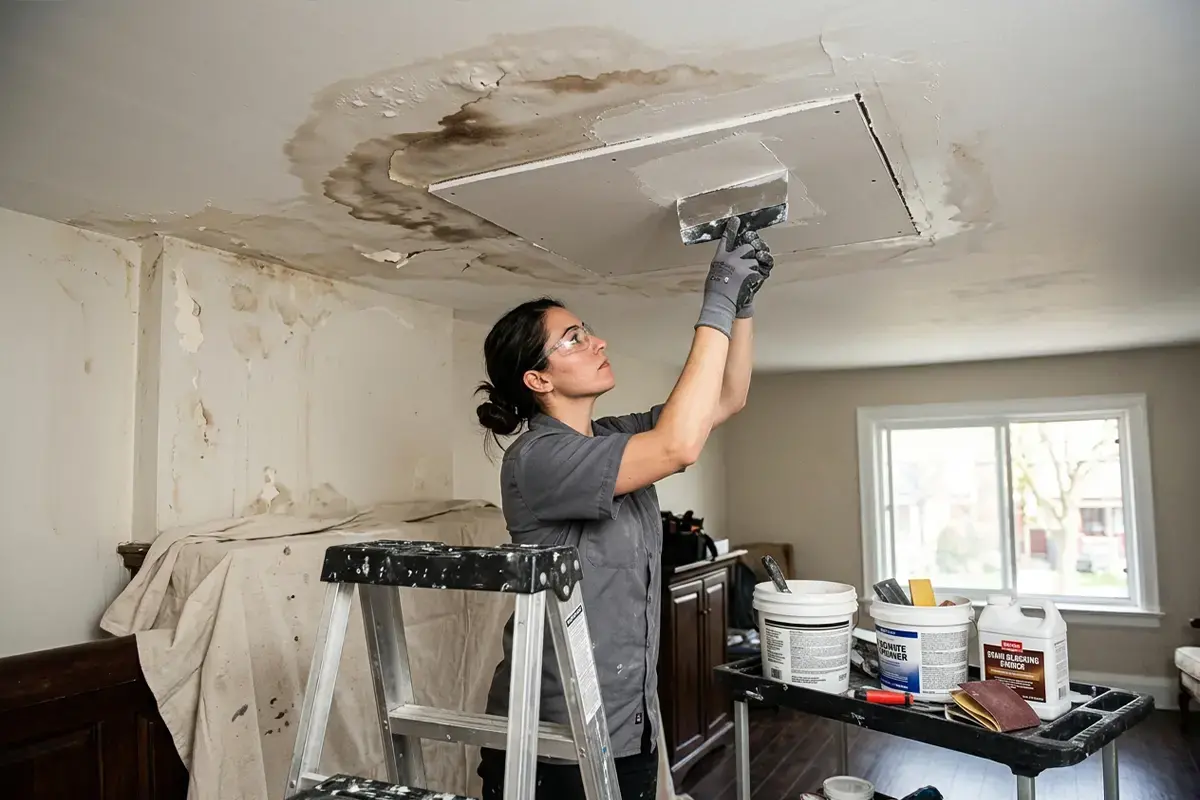
How to Get Water Damage Repair Right the First Time?
Suppose you are noticing a brown ring on the ceiling. A wall that feels soft. Or paint that bubbles for no clear reason. These indicate a leak in your wall. Ignore them if you want to spread the damage. Fix them the wrong way and the stain comes back.
Good water damage repair is not just adding fresh paint. It finds the cause, removes weak material, rebuilds the surface, and seals it. This guide shows you what to do first, what you handle yourself, and when to call an expert.
What Water Does Behind Your Walls
Water doesn't rest in easily visible places. Runs over pipes, joists, and drywall paper. There's a little stain on the ceiling and a wet patch several times the size concealed below. It's a hit to drywall. Absorbs water like a sponge. It becomes soft, expands, and crumbles. Tape joints let go and paint bubbles. It's mould we are worried about. The drying of all wet materials is emphasized in the health advice given in Canada since mould growth begins within 1-2 days.
But Toronto homes are not immune from risks, either:
- Ice buildup on roofs' sides.
- The rainwater that drips from the roof above you
- When spring thaws, moisture levels will be higher in the basement
- Older pipes in your heritage home?
Your Action Plan for First 48 Hours
This is the order in which you should proceed.
- Stop the source. If a pipe is leaking, turn off the main water shutoff.
- Stay safe. If water is close to lights or outlets, disconnect the power from the circuit breaker.
- Do not disturb bulging ceilings. Water traps can cause water to plunge. Keep out of the room, and call a pro.
- Document everything. Before cleaning up, take pictures and videos!
- Start drying. Make sure to use fans and a dehumidifier. If the weather permits, open up windows.
- Call your insurer. Inquire about their needs prior to any repairs.
When You Need a Restoration Crew First
Some jobs need specialists before you initiate any wall repair process. Active flooding, sewage, and soaked insulation all fall into this group. That is when you need emergency water damage restoration. These crews pull out standing water and run industrial drying equipment. When you compare emergency water damage restoration services, look for IICRC certification and 24/7 response.
Bigger losses may call for water damage remediation. This covers contaminated material removal, cleaning, and mould control. Water damage restoration on a large scale takes days or weeks. House water damage restoration after a major flood often involves several trades. We will be direct about our role. PatchWizards does not do drying or extraction. We step in once the source is fixed and the area is dry. Then we rebuild and finish your walls and ceilings.
How to Repair a Water-Damaged Ceiling
Ceilings are the most frequently targeted ones. Let's take a look at how a correct fix is supposed to function.
Step 1: Make sure that the leak has been repaired. Money will be lost if you repair an active leak. The ceiling should be completely dry.
Step 2: Test the surface. Press gently. If it is firm, then a stain-blocking primer may be all that is required. If it is soft, sags, or crumbles, the board needs to be cut out.
Step 3: Repair the damage. Replace the damaged section. Tape the joints. Use thin layers of joint compound. Smooth over the paint between coats with sanding.
Step 4: Seal the stain. Apply a stain-blocking primer. The mark will bleed through with regular paint.
Step 5: Paint. Freshen the ceiling up with the patchwork. This step is important for ceilings that reveal side light faults.
Older homes: Older ceilings (built prior to 1990) may have asbestos—test before scraping/sanding/cutting.
How to Repair Water-Damaged Wood
How to repair water damage on wood depends on how deep the damage goes.
Dry it slowly. Use airflow and a dehumidifier. Direct heat can crack and warp the wood.
Treat surface marks. White rings and light stains often sand out. Refinish with stain and sealer afterward.
Handle dark stains. Wood bleach can lift them. Follow the label and wear gloves.
Check for rot. Press a screwdriver into the wood. If it sinks in easily, the wood is soft. Small spots can be cut back and filled with epoxy wood filler. Larger areas need replacement.
Call a pro for structure. Damaged joists and subfloors affect your home's safety. Do not patch these yourself.
What Professional Water Damage Repair Looks Like
Most people can tell a fresh patch from a good one. A weak repair shows ridges, flashing paint, or a stain that returns. A strong repair disappears.
Our water damage repair service follows a clear process:
- Review your photos: Please include photos of the damage and send some details about the leak.
- Check the surface: Softness, cracking, loose tape, and paint condition are observed.
- Protect your space: Acoustical flooring and furniture to keep the job free of dust.
- Remove weak material: Soft drywall and peeling paint pop out.
- Rebuild the surface: We change out board, tape, mud, and sand.
- Prime and finish: Stain-blocking primer and painting directions are provided.
Our drywall repair work also covers leak cutouts. Plumbers and roofers often open a wall or ceiling to find the source. We close it up so no one can tell. Homeowners across the GTA trust us for this. We hold a 5.0 Google rating from 56 reviews. Recent reviewers mention repairs after pipe leaks, plumber cutouts, and basement water damage. Every repair carries a one-year warranty. We serve Toronto, North York, Etobicoke, Scarborough, East York, Mississauga, Oakville, Vaughan, and Richmond Hill.
How to Choose Water Damage Repair Near You
A search for water damage repair near me returns a mix of restoration firms and finishing trades. Know which one you need. Ask these questions:
- Do you repair the wall or only dry it?
- Will you explain the cause before you start?
- Do you offer a written scope and a warranty?
- Do you protect my home from dust?
- Are your reviews recent and specific?
A good contractor also tells you when you need someone else first. That honesty is a strong sign of a reliable team.
Ready to Repair Water Damage the Right Way?
Once the leak is fixed and the area is dry, do not just paint over it. Weak board and hidden moisture bring the stain back. Let PatchWizards repair water damage properly. Send us a few photos, and we will explain the fix and give you a clear quote. Request your free quote or call today.
FAQs
What is the difference between water damage repair and restoration?
Restoration covers drying, extraction, cleanup, and mould work. Repair rebuilds the damaged wall or ceiling afterward. Many jobs need both, in that order.
Can I paint over a water stain?
Not with regular paint. The stain usually bleeds through. The area must be dry, repaired, and sealed with a stain-blocking primer first.
How do you repair water-damaged wood?
Dry it slowly, sand light stains, and treat dark marks with wood bleach. Fill small soft spots with epoxy filler. Replace rotted or structural wood.
How long does water-damaged drywall take to repair?
Small repairs may finish in one visit. Larger jobs need extra visits because joint compound must dry between coats.
Do you offer emergency water damage service?
We repair walls and ceilings once the source is handled. For active flooding or emergency drying, call a restoration company first.
Is it safe to repair a water-damaged ceiling myself?
Small, dry, firm stains are manageable. Sagging, soft, or bulging ceilings are unsafe. Call a professional.