
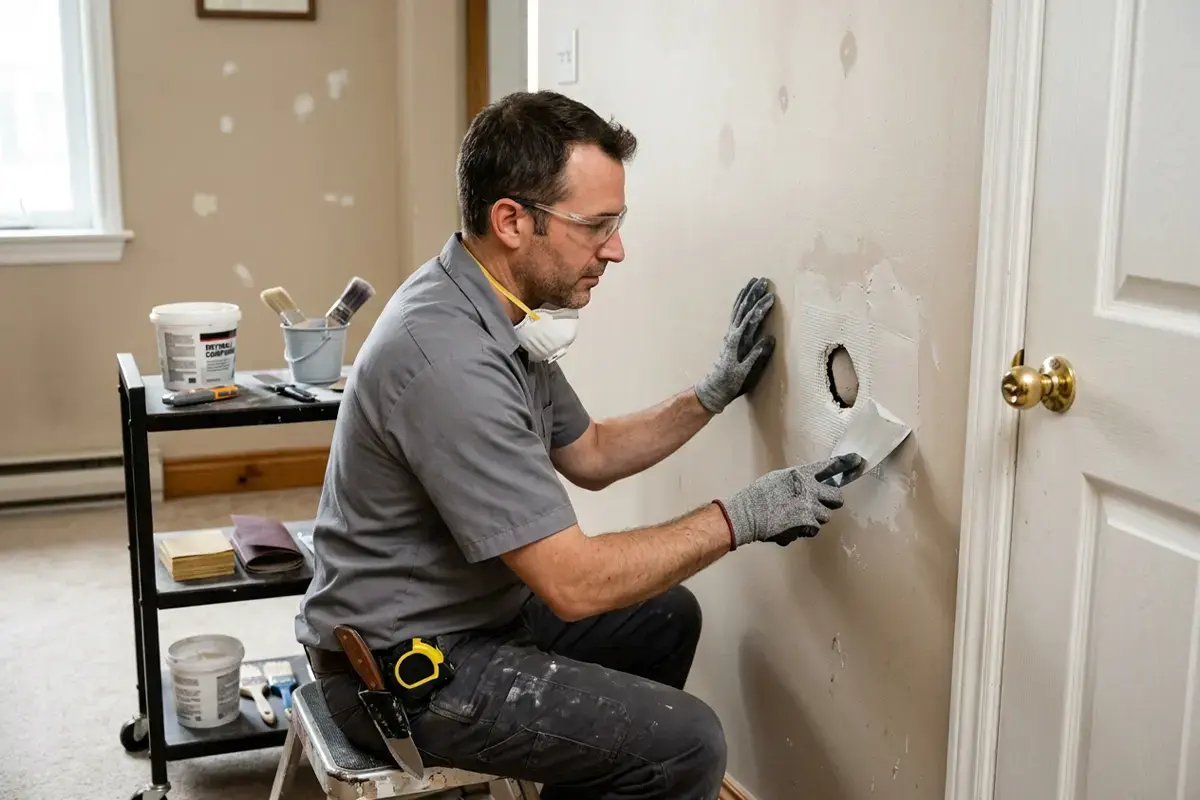
Drywall Repair: Fix Holes Like a Toronto Pro
A doorknob swings too hard. A plumber opens the wall and leaves—a leak from upstairs stains your ceiling. Now you have a hole, a crack, or an old patch that never looked right. Good drywall repair is easy to understand but easy to get wrong. A thin, flat patch takes patience. A rushed one shows every time the light hits the wall.
This guide explains how to repair drywall by hole size, when a simple drywall repair kit is enough, and when to call a pro. We are Patch Wizards, a Toronto team that fixes walls and ceilings across the GTA. We will share what we see on real jobs.
Why Drywall Gets Damaged in Toronto Homes
Walls take a beating. A handful of reasons cause the majority of damage:
- Doors and doorknobs slamming into the wall.
- Furniture is transported in compact halls and condo units.
- The plumbers, electricians, and HVAC workers pulling the wall open. Leaks from roofs, pipes, or upstairs bathrooms.
- Rising or falling humidity levels cause joints and tape to crack, twisting Toronto's homes.
Many of the older homes in East York and The Beaches will have a combination of plaster and drywall. There are elevator booking restrictions in Downtown Condos. When you are looking to rent in Scarborough or North York, the property may require a quick makeover just in time for the next renters. At this stage, many homeowners are looking for drywall repair services. Depending on the cause and the extent of the damage, the right repair can be used. So, be sure to watch carefully before you pick up a putty knife!
Tools and Materials to Gather First
A full workshop is not required. A simple patch kit can be used for minor repairs of drywall. Larger repairs will require some additional items such as:
- Putty knife, 6” and 10” taping knives
- Use a lightweight spackle compound or joint compound, A self-adhesive patch of mesh, or a piece of drywall.
- Drywall Saw and Utility Knife
- Fine sanding sponge (150 to 220 grit)
- Paint for primer and matching paint
- Dust mask, goggles, and gloves. Look for the studs first, then cut.
- Look for wires, too. If you don't know, power down to that room first.
How to Repair a Hole in Drywall by Size
When you're not sure what to do to fix a hole in drywall? Now, begin by taking a measurement of it. The method is determined by its size.
Small Holes and Dents (Under half an inch)
Quick jobs are nail holes, dent holes, and anchor holes. These wall dents can be easily fixed in one afternoon. Remove loose papers from brush. Use the putty knife to fill with light spackle gently. Scrape it level. Allow it to dry and then lightly sand. Prime and paint. One or two thin coats are generally enough for most of the minor repairs.
Medium Holes (Half an Inch to 6 Inches)
What do you do if the hole in drywall is too large to be spackled? Use a patch. A self-adhesive wall hole patch will only last to about three inches.
1- Sand the edges and clean up any loose bits.
2-Cut the mesh about an inch bigger than the hole on every side.
3- Press it down, centered on the hole.
4- Apply compound in a crisscross manner.
5- Feather out the patch edges wide so it gradually blends into the wall.
Allow to dry, sand, and re-coat as required. For holes 3-6 inches, use a California patch. Cut out a square piece of new drywall material and break off the edge of the gypsum (not the paper border). Fill in with compound and press it into the corresponding hole. It's the thin, wide coats that count. The most common error we see is thick blobs.
Large Holes (Over 6 Inches)
What do you do if the hole in drywall is larger? A proper patch is required with support behind.
1-Using a drywall saw, cut a clean square around the damage.
2- Screw onto wood strips behind edges, or onto exposed stud.
3- Cut a new drywall piece to fit.
4- Screw in and drive the heads just below the surface.
5- Tape seams and cover with compound.
The next coat should be wider than the previous, and each should be allowed to dry. Be prepared for 1-3 days. Drying time is longer than the working time. Ceilings are even more difficult. If you're looking at how to repair a hole in a wall, and if that wall is in the ceiling, then you know that light is going to reveal all the flaws in the ceiling.
What Drywall Repair Costs in Toronto
Price depends on the size of the damage, the number of spots, ceiling height, texture, water damage, and paint. Jobs typically range from about $199 to $600+. Ceilings, tape repair, and large patches cost more. They need extra prep and drying time. You may send photos for a firm answer. It is better than guessing.
Why Toronto Homeowners Trust Patch Wizards
We treat drywall repair in Toronto as finish work, not cover-up work. First, we check the damage and the cause. Then we choose the right method, from backing and tape to compound, sanding, and paint-ready prep. Here is what you may expect:
- A free quote within 24 hours when you send photos
- A dust-free process with your floors and rooms protected
- A one-year warranty on our repairs
- A 5.0 Google rating
- Honest advice on paint and texture matching
Our work covers holes, cracks, tape failures, old patches, pot light holes, and Fittes and Aria vent openings. We serve Toronto, Mississauga, Oakville, Vaughan, Richmond Hill, Etobicoke, Scarborough, North York, and East York. Typing drywall repair near me? We answer Monday to Saturday, 8 AM to 7 PM.
Ready to fix that wall? Send one close photo and one wide photo, plus the room type and damage size. Request your free quote or call.
Frequently Asked Questions
How long does drywall repair take?
Small repairs can often be done in one visit. Large repairs, ceilings, and water damage take longer because compound must dry between coats.
Will the patch show after painting?
Many repairs blend well after sanding, primer, and paint. Old paint, texture, and strong light can affect the match. We explain this before we start.
Can I use a wall patch kit myself?
Yes, for tiny dents and small holes. A kit is a poor fit for ceilings, tape damage, and visible living room walls.
Should I repair drywall before or after fixing a leak?
After: repair the leak first, then let the area dry. If you patch too early, the stain or soft spot comes back.
Can you repair drywall without replacing the whole wall?
Yes. Most holes and cracks need only a patch. Soft or water-damaged board may need to be cut out and replaced in sections.